War Doesn't Send a Warning: 8 Steps to Survive the First 60 Minutes of Conflict
War doesn't announce itself with a countdown or a news alert. One night everything is normal, and the next it isn't. What you do in the first 60 minutes determines whether your family survives the next 72 hours.
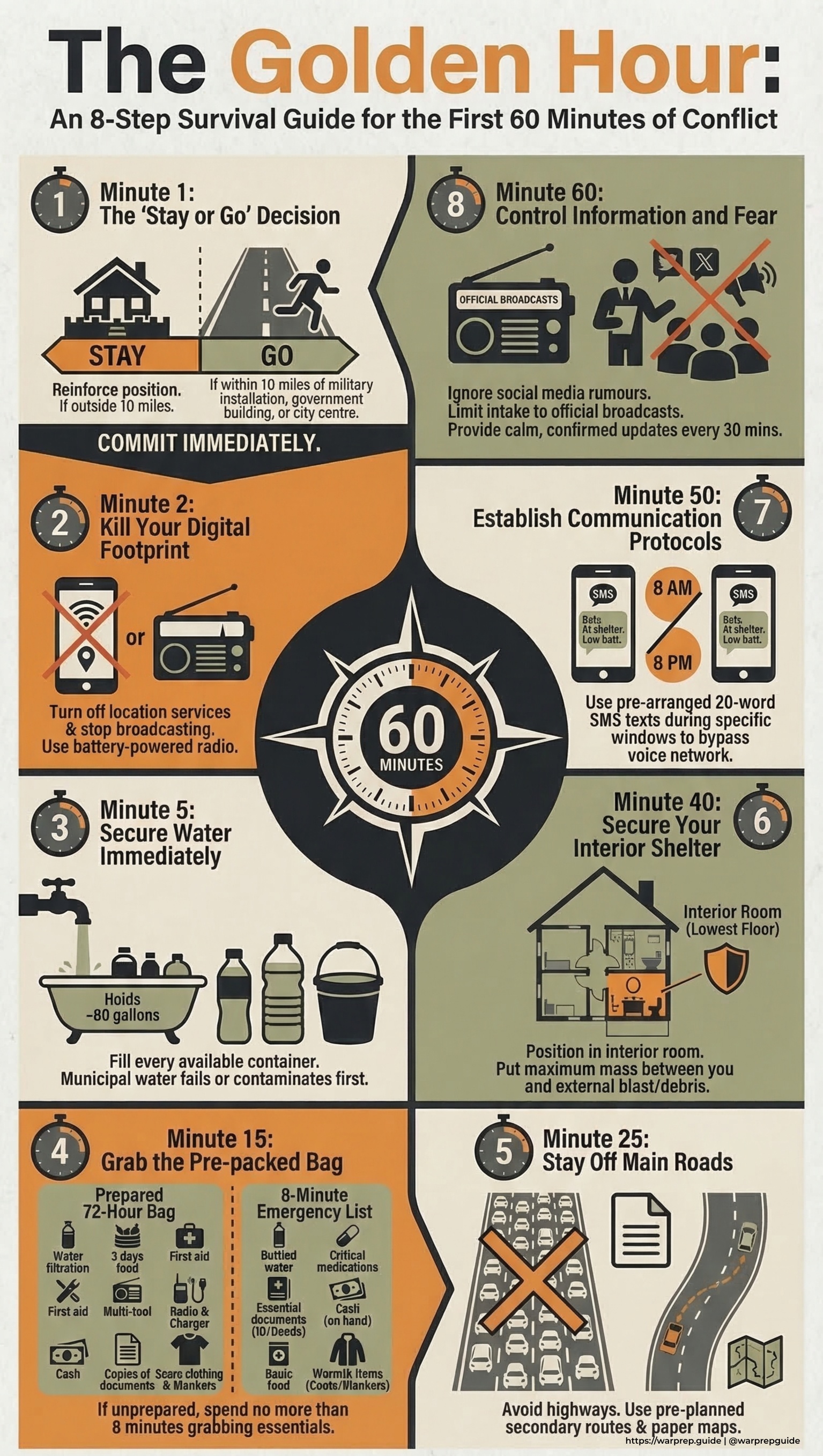
Download this infographic to keep offline
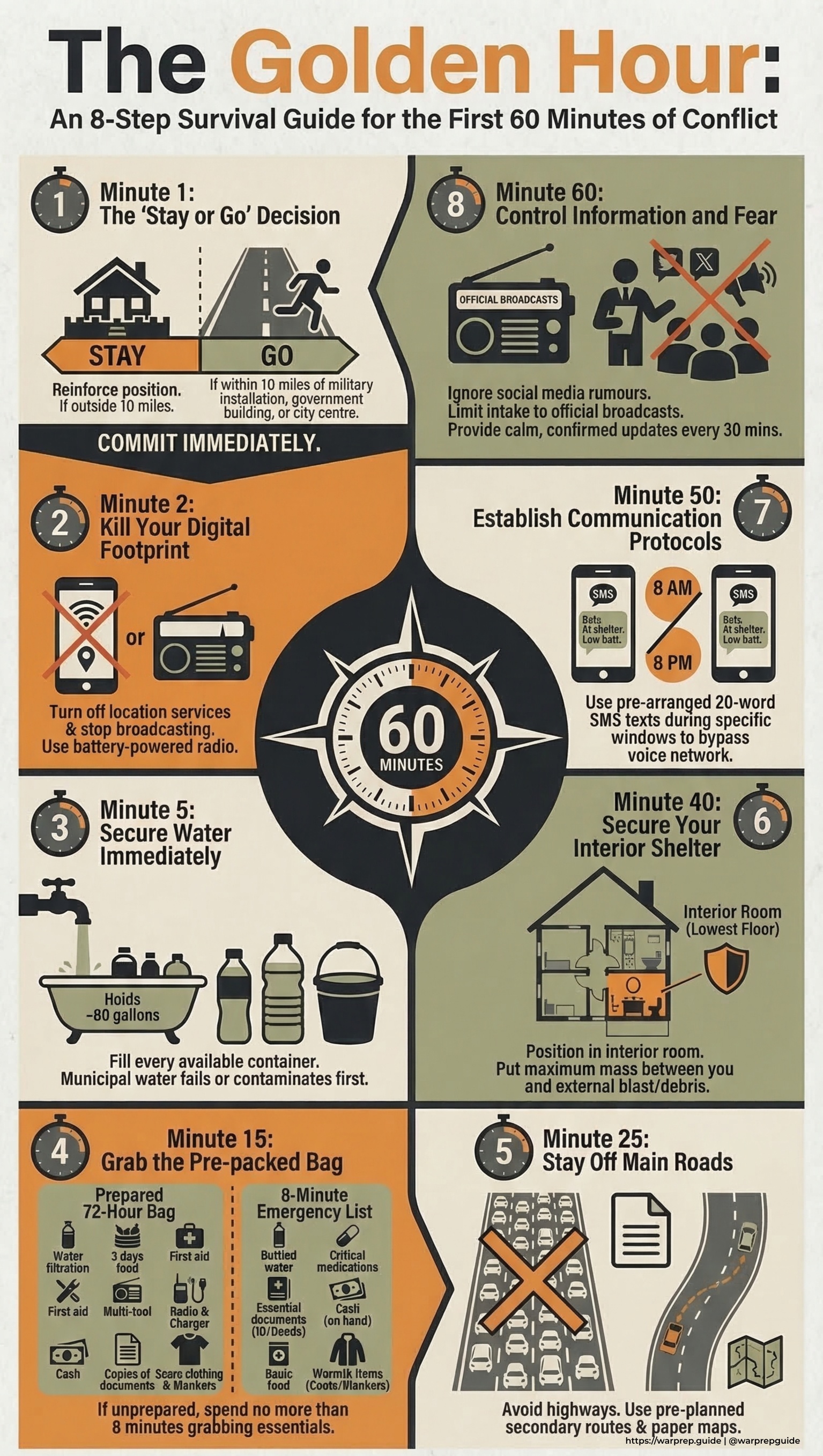
If conflict reaches your city tonight, here is the eight-step survival protocol you must know.
1Decide in 60 Seconds: Stay or Go?
The number one killer in the first hour isn't bullets; it's hesitation. Standing at the window or refreshing your phone costs you the most valuable resource you have—time. You have 60 seconds to make your decision: stay or go.
If you are within 10 miles of a military installation, government building, power facility, or city center — you must leave.
If you are in a rural area, a suburb, or a reinforced structure — you should shelter.
Pick one, commit, and move. Hesitating between the two options kills more civilians than either choice.
2Kill Your Digital Footprint
Your first instinct will be to post on social media, go live, or call everyone you know—doing that could get you killed. In active conflict zones, cellular networks quickly become surveillance infrastructure. Your location services, active calls, and data usage can be tracked and triangulated.
You must immediately turn off your location services, go dark, and switch to a battery-powered radio for your news feed. Old tech cannot be easily jammed and will keep you informed without exposing your position.
3Make Water Your First Priority
Most people instinctively grab food first, which is a critical mistake. You can survive three weeks without food, but you will be dead in three days without water. The moment a conflict begins, municipal water systems are among the first pieces of infrastructure to be disrupted.
Critical Action:
Immediately fill every bathtub, pot, bucket, and bottle you own with tap water. A standard bathtub holds roughly 80 gallons, providing 40 days of drinking water for two people. Do this before you pack or eat, as the window to collect water may be as short as two to ten minutes.
4Grab the Bag, Not the Stuff
Under panic, stress hormones physically narrow your thinking, causing your brain to default to grabbing sentimental keepsakes and replaceable possessions. If you are leaving, you have one job: grab your pre-packed 72-hour bug-out bag and walk out the door.
If you don't have a pre-packed bag, you have exactly 8 minutes to grab essentials in this strict order:
Water → Medication → Documents → Cash → Food → Warmth
Leave the laptop behind. The eight minutes you waste grabbing a laptop is eight minutes you're still in a dangerous location.
5Stay Off Main Roads
The highway is a death trap. Every highway near a major city becomes a gridlocked parking lot within 20 minutes of a major incident. A parking lot full of panicking civilians during an active conflict is one of the most dangerous places you can be.
Before a crisis happens, you need to identify three pre-planned exit routes out of your city using back roads, industrial routes, and rail-adjacent roads. Study these routes on a physical paper map, as paper maps don't run out of battery and will allow you to navigate when everyone else is standing still.
6Secure Your Shelter Position
If you are sheltering, the safest room in your home isn't the basement or your bedroom. It is typically the interior bathroom on the lowest floor. Your goal is to put as much structural mass between you and the outside world as possible.
An interior bathroom lacks exterior windows and is surrounded by dense structural walls and pipes, giving it natural resistance to blast overpressure and shrapnel. Get everyone into that room, get low, and stay low.
7Establish a Communication Protocol
Separated families make desperate decisions. Going back into unsafe areas simply because people don't know where their family is gets people killed. You must set up a communication protocol today:
- Establish one physical rally point (a specific address or landmark) that everyone knows to go to if contact is lost.
- Set two strict check-in times daily, such as 8:00 AM and 8:00 PM, to conserve battery.
- Communicate via text instead of calling, as texts travel faster on congested networks.
- Keep messages under 20 words to simply confirm your location and safety.
8Control Information and Fear
In the first hours of conflict, rumors travel faster than facts. Your neighbors' group chats and social media will be full of unverified, catastrophically wrong information that will spike your panic and destroy your decision-making.
Limit your information intake strictly to official emergency broadcasts. Give your family one clear, calm update every 30 minutes based only on confirmed facts. The person who maintains calm authority and controls information will do more for survival outcomes than almost any physical resource.
The first hour is won or lost in your mind long before it's won or lost in the street.
Most people will never take the time to prepare for this scenario, and they will freeze when it becomes real. The ones who survive are the ones who bookmark this information, print it out, and build a plan.